
By Echos of Gold
A Study in Stillness
There are works that speak loudly, and there are works that listen.
Vigil belongs to the latter.
This piece was conceived not as a statement, but as a presence — a moment held in suspension. It explores the quiet power of observation, the kind that does not rush to act, but instead waits with certainty. In a world driven by immediacy and noise, Vigil stands apart as an intentional pause.
The Owl, Reduced to Essence
The owl has long been a symbol of wisdom, but here it is stripped of myth and excess. What remains is essence.
The form is reduced to its most necessary elements: shape, balance, contrast, and shadow. Every cut, every edge, every plane exists for a reason. Nothing is decorative. Nothing is accidental. The absence of excess allows the figure to speak through restraint rather than detail.
Layered Form and Quiet Depth
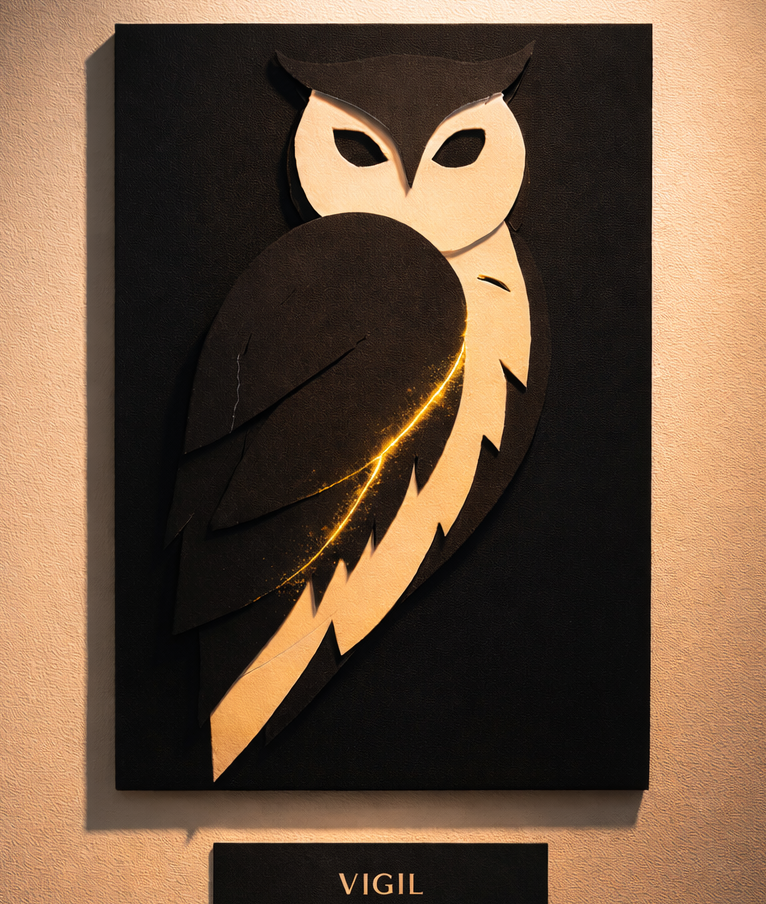
Layering is central to the meaning of Vigil. Built from stacked planes, the owl emerges gradually from the matte black surface, allowing light to define its contours rather than color or ornament.
As the viewer moves, shadows shift. Depth changes. The piece never fully reveals itself all at once. This slow unfolding mirrors the act of vigilance itself — awareness gained over time, not in a single glance.
Black as Foundation
Black dominates the composition not as emptiness, but as structure.
It absorbs light, quiets the surrounding space, and creates a visual stillness that invites contemplation. Against this darkness, the white elements are deliberate and restrained, forming the owl’s face and body with calm precision. The contrast is stark yet balanced, reinforcing the tension between clarity and concealment.
The Gold Line
Gold is used sparingly — and intentionally.
Rather than outlining the figure or framing it, the gold traces a subtle, flowing path through the wing. It behaves almost like a fault line or a quiet pulse, suggesting inner knowing rather than outward display. This gold does not announce itself. It reveals itself only when the light catches it.
Gold was historically a symbol of power and divinity. Here it becomes something quieter — intuition and awareness. It marks the moment when understanding surfaces. It is the echo that remains after silence.

The Gaze
The owl’s gaze defines the emotional center of the work.
It does not confront the viewer, nor does it retreat. It simply watches. There is no judgment in its eyes — only presence. This creates an inversion of the traditional viewing experience. The artwork does not ask to be interpreted; instead, it reflects the viewer back onto themselves.
You become aware of being seen.
Scale and Presence
Scale plays a critical role in how Vigil is experienced.
The vertical format emphasizes balance and stillness, giving the figure a grounded authority without aggression. The piece does not loom, yet it commands space through restraint. It holds its ground quietly.
Light, Time, and Change
Throughout the day, Vigil evolves.
As light shifts, the gold line warms and cools. Shadows deepen and soften. The layered forms reveal new relationships between surface and void. The work rewards time. It invites the viewer to stay longer than intended.
What Vigil Holds
This is not a narrative piece. There is no single story being told.
Instead, Vigil offers a state of being — the moment before action, before decision, when awareness sharpens and intention forms.
It is about presence without urgency.
Strength without force.
Attention without intrusion.
Some power moves forward.
Some power waits.
 Echos of Gold by S.Walton
Leave a comment